
The Beauty of Sojiwan Temple Tourism and Its History

Sojiwan Temple Tourism: Perhaps not many people have heard of it, especially when asked where it is located. Indeed, Sojiwan Temple is not as well-known as Prambanan Temple, let alone Borobudur Temple. It's actually not far from Prambanan Temple, taking perhaps half an hour on foot. Recently restored in 2011, this temple is relatively new compared to the other temples. What's most striking about this temple is its similar shape to Prambanan: tall with a pyramid-like structure on top, but the upper part of the temple consists of stupas similar to those at Borobudur. It could be said that this temple is like a "marriage" between Prambanan and Borobudur. This temple is situated within a fairly extensive complex with beautiful, well-maintained gardens. It turns out that this complex was only inaugurated after being restored in December 2011 by the Minister of Education and Culture, Mohammad Nuh. Initially, this temple was only a half-finished structure that looked like a ...

Umbul Cokro, a Recommended Nature Tour in Klaten

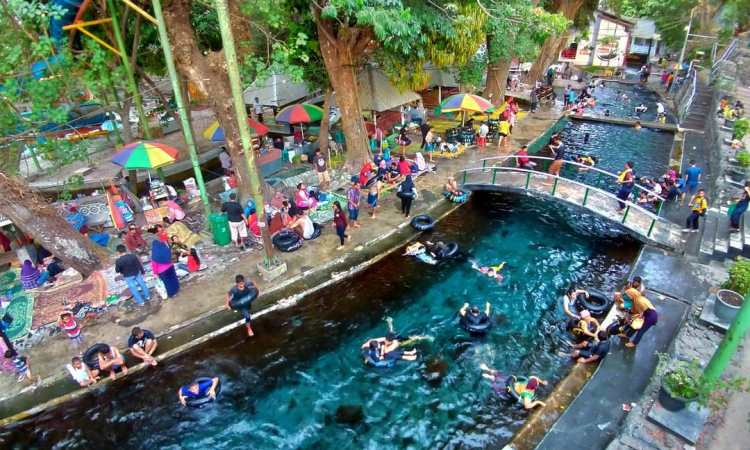
Umbul Cokro or Cokro Spring Object (OMAC) is one of the most widely known tourist attractions in Klaten. OMAC is located on Jalan Cokro-Tulung, Cokro Village, Tulung District, Klaten Regency, Central Java. Before being used as a tourist attraction, Umbul Cokro was utilized by local residents for various things. Umbul Cokro is a river that has a high water discharge. The water in Umbul Cokro is abundant and clear.
Umbul Cokro, a Recommended Nature Tour in Klaten

Reporting from a thesis entitled Dynamics of Utilization of Umbul Ingas Cokro Springs by the Community in 1974-1999 by Putri Novitasari in 2019, said that around 1950 local residents could still bathe free of charge. Apart from bathing, Umbul Cokro is used for washing and irrigation. The river or Umbul Ingas was then renovated by the village government (pemdes) into a building. Since then, the Ingas River has changed its name to Umbul Ingas spring. The spring was developed into a tourist attraction called OMAC.

After the renovation, the spring attracted tourists. Umbul Cokro spring is also used for irrigation of rice fields and drinking water. Umbul Cokro spring is mostly used by the Surakarta Regional Drinking Water Company (PDAM) and bottled water industry companies. This utilization has reduced the availability of Umbul Cokro water. Umbul Cokro is also often used for kungkum rituals. The kungkum ritual starts from 23.00 WIB-02.00 WIB.

Umbul Cokro, a Recommended Nature Tour in Klaten

The condition of Umbul Cokro in the past was not as neat and clean as it is now. In the past, the umbul was still deserted, only in the form of empty land and no flowing springs. Umbul Cokro is also used as a place for padusan which is held every year. Padusan is a tradition for the community to clean themselves and prepare for the month of Ramadan. Padusan is usually held one week before Ramadhan. The padusan is not only attended by the Cokro community. But also people from Delanggu, Tegalgondo, and Juwiring. 

Now, Umbul Cokro has become a tourist attraction that is visited by many tourists. OMAC has many rides that pamper tourists. With affordable entrance tickets, tourists can enjoy the beauty and excitement of traveling at OMAC.

Umbul Cokro, a Recommended Nature Tour in Klaten

The entrance ticket price to Umbul Cokro Klaten is IDR 15,000. The price applies to every visitor who comes, both children and adults. While parking fees at Umbul Cokro are still quite affordable, which is IDR2000 for motorcycle parking and IDR5000 for car parking. Umbul Cokro Klaten is open every day, from 8am to 5pm.

Comments

Trending Topics

Getting to Know Padusan, a Unique Tradition of Javanese People Welcoming Ramadan

The tradition of Padusan before Ramadan is an ancestral heritage that is still carried out by the Javanese community. Padusan was practiced by the community before Islam entered Java. During the Majapahit Kingdom, knights, poets, brahmins and masters often performed padusan to purify themselves. The tradition has survived until now, thanks to the role of Wali Songo who preached with a cultural approach. In general, the meaning of padusan is a bathing tradition that is usually carried out before Ramadan by Javanese people. However, to understand further what is padusan and how to read the padusan intention and the procedure for doing it? What is Padusan? According to Retno Widyastutik's research in the publication of Surakarta State University (UNS), padusan comes from the word adus which means bathing. The padusan tradition is carried out the day before Ramadan, precisely from noon to evening. When carrying out the padusan tradition, Javanese people will generally bathe or soak in ...

Umbul Kroman, a Hidden Paradise in Mranggen Village, Klaten

When talking about water tourism in Klaten, Central Java, the immediate image of a row of popular springs always crowded with visitors is likely to come to mind. However, amidst the hustle and bustle of these massively managed tourist destinations, lies a small, pristine spring: Umbul Kroman. Located in Mranggen Village, Jatinom District, Klaten Regency, Umbul Kroman offers a unique experience. Far from ticket booths, commercial stalls, and the throngs of tourists, this spring offers a tranquil oasis for those who manage to find it. To reach it, visitors must venture into the village's residential area. The main attraction of Umbul Kroman is its pristine beauty. The natural rocky bottom and lively swimming of small fish are visible to the naked eye. On one side of the pool, a spring constantly gushes fresh water from the earth, testifying to the purity of the water source here. The beauty doesn't stop at the pool. Right next to the spring, a small river flows with equally clear...

The Enchantment of Sojiwan Temple in Prambanan Klaten, the Relief is Rich in Stories and Moral Messages

Sojiwan Temple is located in Kebon Dalem Kidul Village, Prambanan District, Prambanan Regency. This temple is one of the Buddhist temples included in the Prambanan area. Based on some research, Sojiwan Temple was built at the same time as the nearby temples, namely in the IX-X centuries AD. The Central Java Cultural Heritage Preservation Center has finished restoring and organizing the environment to make the temple so beautiful. Sojiwan Temple is unique. This uniqueness comes from several relief panels that tell animal stories. If understood more deeply, these stories convey moral messages that are timeless. These moral messages are also very useful for daily life.  After the research, there were some interesting findings. One of them is the traveling ditch. Some of these ditches are located in residential areas. Inside the perimeter ditch, statues, temple foundations, fence structures, temple stones (loose), structures and temple stones were found around the residential area loca...