Sojiwan Temple Tourism: Perhaps not many people have heard of it, especially when asked where it is located. Indeed, Sojiwan Temple is not as well-known as Prambanan Temple, let alone Borobudur Temple. It's actually not far from Prambanan Temple, taking perhaps half an hour on foot. Recently restored in 2011, this temple is relatively new compared to the other temples. What's most striking about this temple is its similar shape to Prambanan: tall with a pyramid-like structure on top, but the upper part of the temple consists of stupas similar to those at Borobudur. It could be said that this temple is like a "marriage" between Prambanan and Borobudur. This temple is situated within a fairly extensive complex with beautiful, well-maintained gardens. It turns out that this complex was only inaugurated after being restored in December 2011 by the Minister of Education and Culture, Mohammad Nuh. Initially, this temple was only a half-finished structure that looked like a ...
Gedaren (Javanese: Gedarèn) is a village in Jatinom sub-district, Klaten, Central Java, Indonesia. Gedaren village consists of 10 Rw and several hamlets including Potrosaren, Barakan, Ngangkruk, Surobayan, Meleman, Susuhan, Gedaren, Gumux, Blok v, Tegalrejo, Pancasan, Derepan, Ketinggen, Perkiosan.

Umbul Gedaren is one of the tourist attractions located in Gedaren Village, Jatinom District, Klaten Regency. The Umbul not only shows off its water clarity but also plays an important role in the daily life of the local community, besides being used for bathing and washing, the abundant water that comes out of Umbul Gedaren can also be used to irrigate 20 hectares of rice fields.
Gedaren Village Head, Sri Waluyo, said that the name Umbul Gedaren originated from the word "dar" which was taken from the name of one of the umbul watchers named Mrs. Dewi Siti Sundari. After that, the old people added the prefix "Ge" with the suffix "ren" which eventually became Gedaren. Umbul Gedaren itself has two springs named Umbul lanang (western part) and Umbul Wadon (eastern part). It is said that the western umbul is guarded by a creature from another realm named Kyai Jegang Joyo while the eastern part is guarded by Mrs. Dewi Siti Sundari.
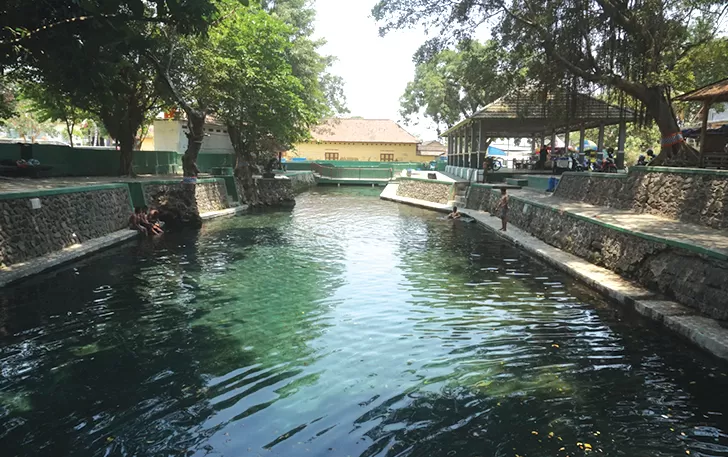
In the western umbul, mystically split into two parts, namely north and south, the difference from the split umbul will be felt if at night it is used for bathing. In the northern part when used for bathing the water feels very cold, while the southern part if used for bathing for hours will not feel cold, some even say the water feels warm. "The umbul that is mystically split in two is one location (pond), but the water here really feels the difference, because I myself have tried it," said the village head.
It is believed by local residents that the cold water (the northern part) is used as a means of asking the Almighty for peace, while the warm water (the southern part) is believed to be a means of asking the Almighty for rank, degree and so on.

Sri Waluyo further explained, according to the story of the old people, the eastern umbul location has a uniqueness that anyone who has a face that does not look beautiful if bathing in the umbul will then look charming, clean and beautiful.
Comments